| ENGLISH VERSION |
MSU Brightness Independent PSNR
(BI-PSNR)
MSU Graphics & Media Lab (Video Group)
Project, Ideas: Dr. Dmitriy Vatolin
Implementation: Alexey Noskov
Updating and additions: Sergey Grishin
Common idea
BI-PSNR metric is intended for measuring distortions in video taking into account brightness shifts.
Change Log
[!] - Known bug
Version 1.1
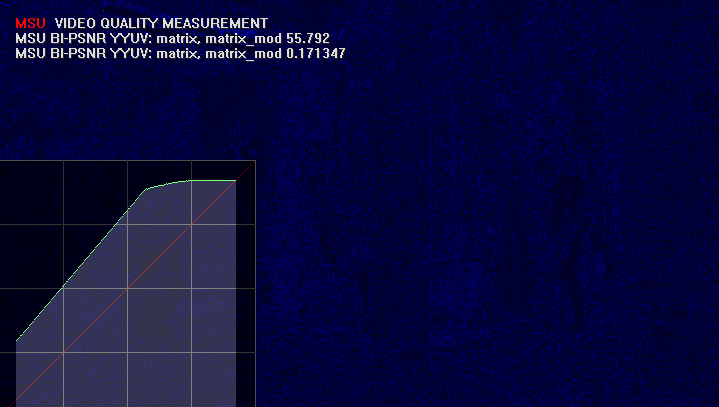
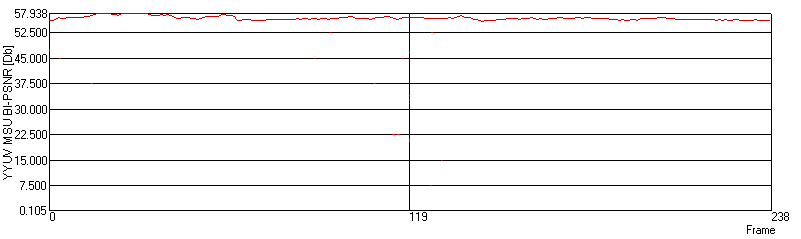
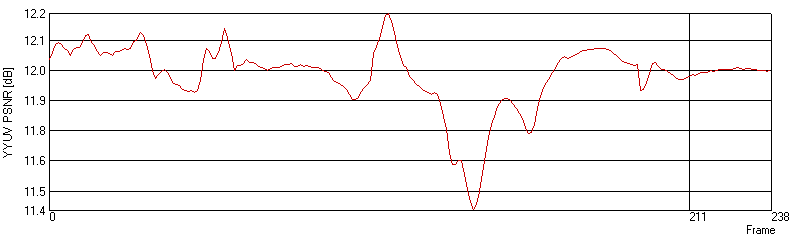
Version 1.0 BI-PSNR metric should be used when one of the sequences has any brightness transformation, which does not change within frame. Example of such transformation is uniform increasing of brightness of contrast for single frame of for all sequence. Such transformations prevent usage of standard metrics because of strong brightness difference between comparing frames. BI-PSNR algorithm calculates brightness transformation, which makes frames similar as possible and calculates standard PSNR and MSE metrics taking into account founded transformation. There are two part of visualization: Plots of per-frame PSNR values after the found transformation are drawing after all calculations. Plots are entirely the same as standard per-frame PSNR Table C[i,j] is filling for each frame: C[i,j] = { number of points in the same position, which have brightness i at the first sequence frame and j at the second sequence frame } Next, for each i (brightness value from the first frame) we find corresponding brightness from the second sequence. Following formula is used to estimate distanse from arbitrary values of i and j:
[+] - New Feature
[*] - Other
[*] Visualization bug fixed for non-stadard resolution video
[+] First plugin release
Usage
Visualization

Plots
Algorithm

One can note that this formula is sum of quadratic differences between all pixels of the first sequence with value i and all corresponding pixels from second sequence on the assumption that brightness was shifted to i-j.

When transformation was found, we can find MSE for the frame taking into account this transformation:

Download
- Metric's sources for VS 2013
- MSU Video Quality Measurement Tool
- License text for sources and binary files (LGPL)
MSU Video Quality Measurement Tools
| e-mail: |  |
Other resources
Video resources:
Server size: 8069 files, 1215Mb (Server statistics)
Project updated by
Server Team and
MSU Video Group
Project sponsored by YUVsoft Corp.
Project supported by MSU Graphics & Media Lab